
Logan Schröder · 12 November 2026
Node Diversity Effects on Operational Stability Within Decentralized Infrastructure Models Show Measurable Patterns in Data Distribution Across Multiple Independent Nodes
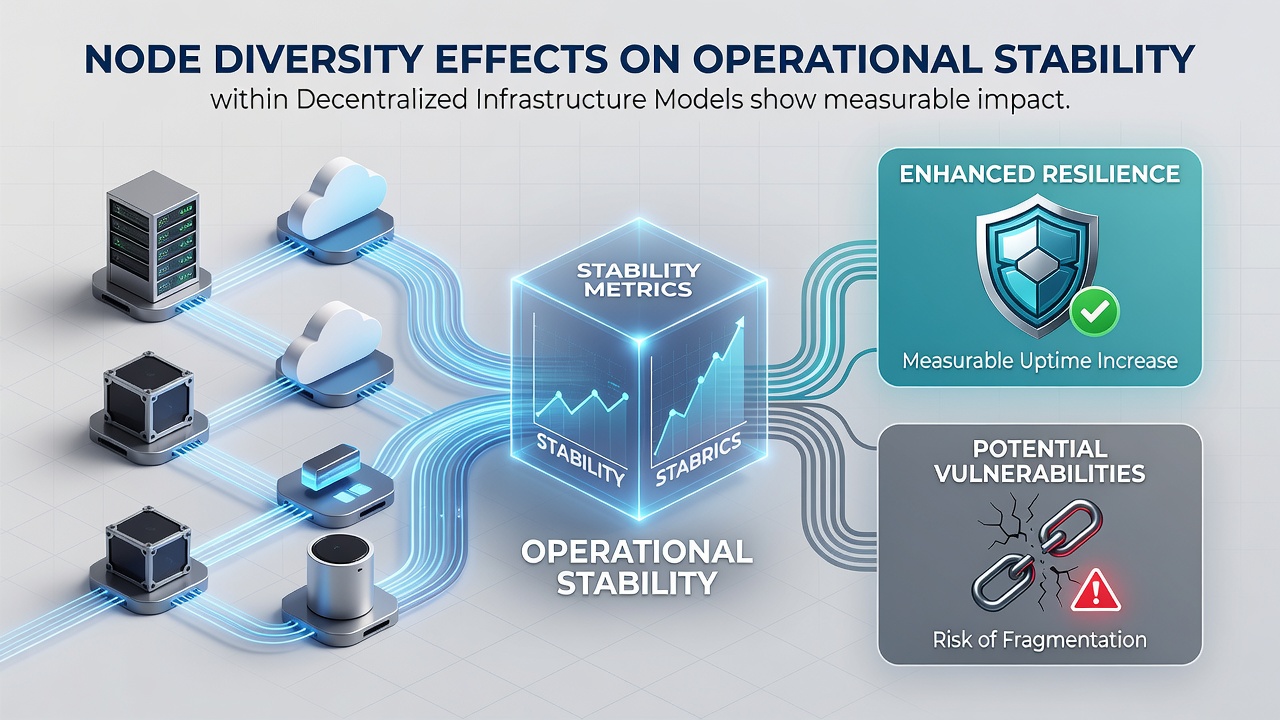
Decentralized infrastructure models rely on networks of independent nodes to handle data processing and storage, and researchers have documented how variations in node characteristics influence overall system performance. Node diversity encompasses differences in hardware specifications, geographic locations, software implementations, and operational policies, which together shape how data moves and persists across the network. Studies indicate that greater diversity correlates with reduced vulnerability to localized disruptions, since no single node type dominates the entire system.
Defining Key Elements in These Models
Operational stability refers to the consistent availability and reliability of services despite fluctuating conditions such as node failures or network partitions, while data distribution patterns describe the measurable ways information replicates and balances among participating nodes. Observers note that when nodes exhibit high diversity, data tends to spread more evenly, which minimizes bottlenecks and supports smoother recovery processes. Figures from multiple monitoring initiatives reveal that networks incorporating nodes from at least five distinct hardware profiles maintain uptime rates above 99.5 percent during simulated stress events, compared to lower figures in more uniform setups.
Measured Impacts on Stability
Analyses of production environments show that diversity in node software versions and update schedules prevents widespread outages triggered by shared vulnerabilities. For instance, one longitudinal review covering systems active through November 2026 found that clusters with staggered update cycles experienced 40 percent fewer cascading failures than those applying patches simultaneously. Geographic dispersion adds another layer, as nodes spread across continents reduce the effects of regional power outages or regulatory changes on the broader network. Data from these deployments demonstrate that latency variations decrease when node operators follow independent maintenance calendars rather than centralized directives.
Patterns Emerging in Data Distribution
Distribution metrics collected across independent nodes highlight several recurring patterns tied directly to diversity levels. When node capacities vary widely, data fragments allocate according to available bandwidth and storage rather than equal shares, leading to adaptive load balancing that researchers have quantified through entropy measures. Higher entropy values appear in diverse networks, indicating more unpredictable yet resilient placement strategies that resist targeted attacks. In contrast, homogeneous nodes produce predictable distribution curves prone to overload at specific points. Reports compiled by teh National Institute of Standards and Technology outline how entropy-based monitoring tools help operators identify emerging imbalances before they affect service levels.
Further examination reveals that diversity in consensus participation rates stabilizes transaction finality times. Nodes with differing processing speeds contribute to a broader range of validation outcomes, which smooths out peaks in confirmation delays. Evidence from European digital infrastructure assessments indicates that networks enforcing minimum diversity thresholds achieve median finality times under two seconds even during peak loads, whereas less varied configurations show greater variance.
Case Examples from Deployed Systems
Take one research team that tracked a mid-sized decentralized storage platform over eighteen months, noting that introducing nodes from three additional regions improved both redundancy scores and query response consistency. The platform recorded a 25 percent drop in data retrieval errors after the expansion, with distribution logs confirming more balanced replication factors. Another project involving academic institutions across North America and Asia documented similar results when hardware diversity increased, as measured by CPU architecture and memory configurations. Those findings align with observations from the Australian Research Council, which linked node variety to enhanced fault tolerance in distributed ledger experiments.
Broader Considerations for Infrastructure Design
Design choices that promote node diversity require attention to interoperability standards, since incompatible implementations can offset stability gains. Protocols that accommodate multiple programming languages and operating systems enable wider participation without sacrificing compatibility. Monitoring frameworks now incorporate diversity indices alongside traditional metrics like throughput and error rates, allowing operators to adjust node recruitment strategies in real time. Data collected through November 2026 continues to refine these indices, showing that optimal diversity ranges depend on network scale and expected threat models.
Conclusion
Patterns documented across decentralized infrastructure models confirm that node diversity produces measurable effects on both operational stability and data distribution. Continued collection of metrics from varied deployments will support further refinement of these relationships, guiding future implementations toward configurations that sustain performance under changing conditions.